
Evidence Review · The Journal
Reflexology vs Foot Massage — What's the Difference?
Two traditions, one pair of feet. Reflexology is $35 for 30 minutes here and so is a plain foot massage, because we do both in the same chair.
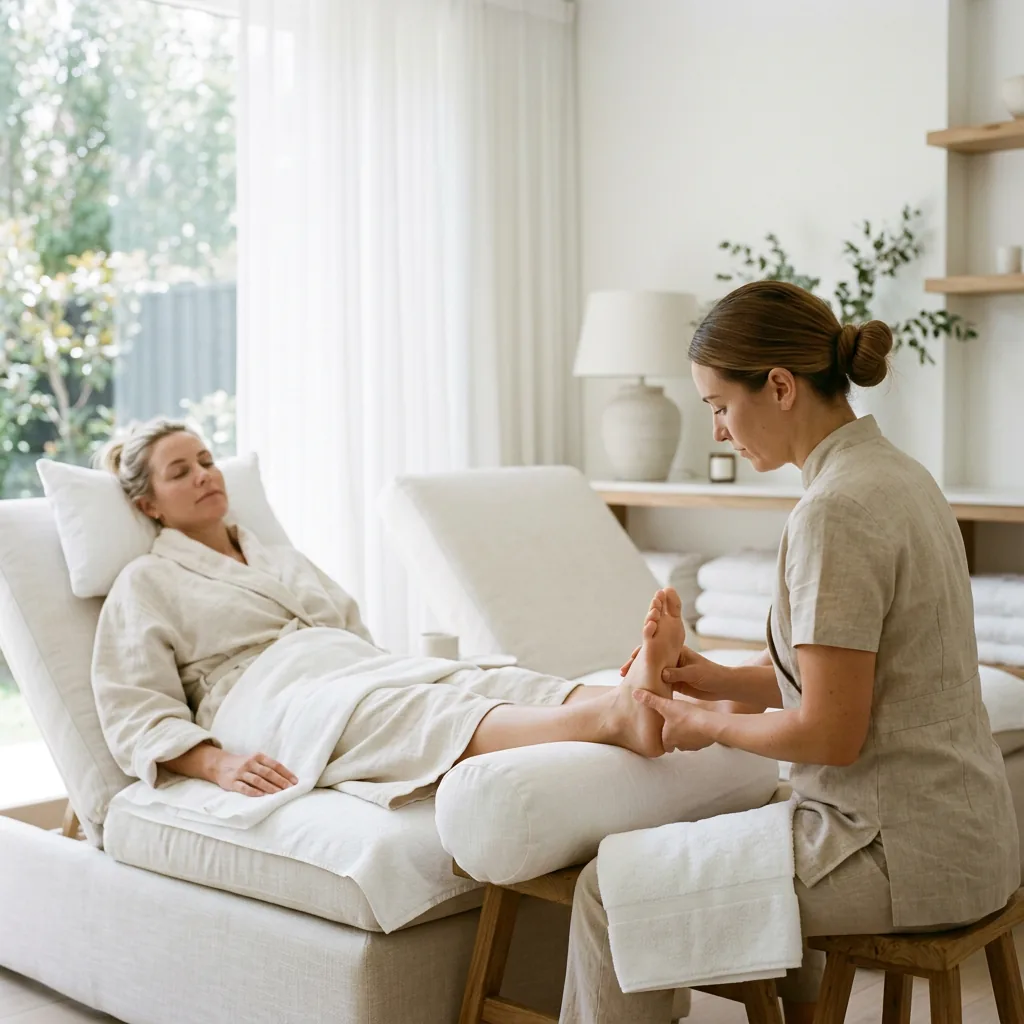
A foot massage works the foot; reflexology works a map. Both cost $35 for 30 minutes at our studio on East 55th Street, both open with a hot herbal soak, and from the chair the two can feel almost identical. The difference is what the practitioner thinks is happening under the skin — and one of those two ideas holds up a lot better than the other.
The one-sentence answer
Foot massage is bodywork aimed at the foot. Reflexology is bodywork aimed at the rest of you, delivered through the foot. That's the whole distinction. A foot massage therapist is trying to loosen the plantar fascia, the small muscles between your metatarsals and the calf above them. A reflexologist is pressing points on the sole that a chart assigns to your liver, your sinuses, your lower back.
Same room. Same soak. Very different theory. And the theory matters, because it's the part people quote to each other and the part that gets oversold.
What a foot massage actually does
Nothing mystical, which is the point. A foot massage is mechanical work on a structure that takes an absurd amount of load. Your feet carry you through the day on Manhattan concrete, inside shoes chosen for a meeting rather than for walking, and the tissue that absorbs all of it is thin and doesn't get stretched much on its own.
The tissue
Under your arch runs the plantar fascia, a broad band of connective tissue from heel to toes. Over a long day it stiffens. The small intrinsic muscles between your toe bones grip constantly to keep you balanced, and they don't get a break unless you're lying down. A therapist working the sole is doing three things: warming the tissue so it moves more easily, applying enough sustained pressure to make the fascia give, and moving the joints of the midfoot and toes through ranges they never reach in shoes.
You feel it as looseness. The floor feels different when you stand up — that's not poetry, it's a real change in how the foot loads. It fades over a day or two, which is why frequency matters more than intensity.
The calf nobody asks for
Here's the part most people don't expect and end up liking most. Half of what makes a foot ache isn't in the foot. Your calf muscles connect through the Achilles tendon straight into the heel, and a tight calf keeps the heel loaded whether you're standing or not. Any competent foot session goes up past the ankle and works the calf for several minutes on each side. If a place skips it, you're getting half a treatment.
That's one of several reasons the 30-minute session is a different product from the 60. Thirty minutes covers both feet properly and not much else. Sixty gets the calves, the ankle joints and a second pass over whatever was worst.
What reflexology claims
Reflexology starts from a much bigger idea: that the surface of the foot corresponds, point by point, to the whole body. Press the right spot and you're supposedly doing something to an organ a an arm and a torso away.
The maps
The charts you've seen in every foot spa in the city — sole divided into colored regions labeled heart, kidney, sinus, spine — come from a fairly recent lineage. An American physician, William FitzGerald, published a system he called zone therapy in 1917, dividing the body into ten longitudinal zones. A nurse and physiotherapist named Eunice Ingham refined it into the foot maps used today through the 1930s and 40s. Older Chinese and Egyptian foot-work traditions get cited as ancestors, and there's some truth in that, but the modern chart is roughly a century old, not ancient.
Practitioners describe tender or gritty points as signs of trouble in the corresponding zone, and treat sustained pressure there as a way of clearing it. The technique itself is real and specific: thumb-walking, a caterpillar-like sequence of small firm presses, held longer than the strokes of a regular massage.
What the evidence actually says
This is where we're going to be less enthusiastic than most spa websites.
The claim that a point on the sole maps to an internal organ has been tested, and it hasn't held up. Trials that ask reflexologists to identify a patient's known medical condition from the feet alone don't produce accuracy better than guessing. There's no anatomical structure — no nerve tract, no vascular route — that would carry a signal from the ball of the foot to the lungs in the way the charts describe. Reviews of reflexology trials for specific diseases tend to conclude that the studies are small, rarely blinded properly and inconsistent with each other.
The National Center for Complementary and Integrative Health, the U.S. National Institutes of Health body that reviews exactly this literature, summarizes what massage therapy has reasonable evidence for: pain, anxiety, and general wellbeing, mostly in the short term. Reflexology's organ claims are not in that summary. Its overview of Traditional Chinese Medicine is similarly careful, noting that rigorous evidence is thin for a lot of what gets practiced under that heading.
“The silence is the finding. When a federal research center sums up what massage is good for, and the organ maps aren't in the summary, that's an answer.”
Pressing the arch of your foot detoxifies your liver and clears your sinuses.
There is no anatomical pathway for that and no good trial showing it. What firm sustained pressure on the sole reliably produces is local tissue change and a strong relaxation response — which is worth real money, just not for the reason on the chart. See the NCCIH massage therapy overview.
So why does an hour of it feel excellent. Because everything else about it is real. Firm, predictable, sustained pressure on a densely innervated part of the body, in a warm quiet room, for an uninterrupted hour, is one of the more efficient ways a human being can downshift. The Mayo Clinic groups massage with the relaxation techniques it describes as useful for stress — slower breathing, lower muscle tension, better sleep for some people. None of that requires the map to be true.
Side by side, the honest comparison
| Foot massage | Reflexology | |
|---|---|---|
| What's being treated | The foot and calf — skin, fascia, muscle, joints | The whole body in theory, through zones mapped on the sole |
| Where it comes from | Massage traditions everywhere, including Chinese tui na | Zone therapy, published 1917; foot charts refined in the 1930s |
| Technique | Kneading, stroking, thumb glides, joint mobilizing, calf work | Thumb-walking: small firm presses held on specific points |
| Pressure | Whatever you ask for, light through firm | Firm and point-specific; tender spots get held |
| Evidence for relaxation | Reasonable, and consistent across studies | Similar — the trials mostly measure the same outcomes |
| Evidence for treating organs | None claimed | Not supported by good-quality research |
| What you take off | Shoes and socks, trousers to the knee | The same |
| What we charge | 30 minutes $35 · 60 minutes $55 | Identical — one session, both techniques |
- Foot massage
- The foot and calf — skin, fascia, muscle, joints
- Reflexology
- The whole body in theory, through zones mapped on the sole
- Foot massage
- Massage traditions everywhere, including Chinese tui na
- Reflexology
- Zone therapy, published 1917; foot charts refined in the 1930s
- Foot massage
- Kneading, stroking, thumb glides, joint mobilizing, calf work
- Reflexology
- Thumb-walking: small firm presses held on specific points
- Foot massage
- Whatever you ask for, light through firm
- Reflexology
- Firm and point-specific; tender spots get held
- Foot massage
- Reasonable, and consistent across studies
- Reflexology
- Similar — the trials mostly measure the same outcomes
- Foot massage
- None claimed
- Reflexology
- Not supported by good-quality research
- Foot massage
- Shoes and socks, trousers to the knee
- Reflexology
- The same
- Foot massage
- 30 minutes $35 · 60 minutes $55
- Reflexology
- Identical — one session, both techniques
What the same hour costs elsewhere in Midtown
Read off each studio's own menu or its booking-marketplace listing in August 2026. Only genuine 60-minute foot or reflexology sessions are in the table — deep-tissue clinics sell a different hour and are not comparable on price.
| Studio | Where | Published rate | For |
|---|---|---|---|
| U Beauty & Foot Spa (us) | 146 East 55th Street | $55 | 60 min |
| Union Spa NYC | 211 E 43rd St | $145 | 60 min |
| Siya Healing Spa | 56 W 39th St | $140 | 60 min |
| Luxsa Thai Spa | 274 Madison Ave | $140 | 60 min |
- Where
- 146 East 55th Street
- Published rate
- $55
- For
- 60 min
- Where
- 211 E 43rd St
- Published rate
- $145
- For
- 60 min
- Where
- 56 W 39th St
- Published rate
- $140
- For
- 60 min
- Where
- 274 Madison Ave
- Published rate
- $140
- For
- 60 min
That is a spread of $140–$145 against our $55, and the gap is not a promotion — it's the standing price, seven days a week, 9:30 AM to 9:30 PM.
Which one should you book
In most of New York this question is theoretical, because almost nowhere sells them separately. If you've booked a Chinese-style foot massage in Midtown, you've had both. But if you're choosing an emphasis, here's how we'd steer you.
- Feet hurt from walking or standing. Ask for foot massage emphasis with real calf work. This is the case for tourists, nurses, retail staff and anyone who did twenty thousand steps of Manhattan concrete in a day.
- Heel pain first thing in the morning. Also foot massage emphasis, worked slowly around the heel and arch. Read our guide to foot massage for plantar fasciitis before you book, because there are limits worth knowing.
- Wired, tense, can't switch off. Reflexology emphasis suits you better. The slower, held pressure of thumb-walking is more hypnotic than brisk kneading, and the hour goes somewhere.
- Neck and shoulders are the real problem. Then feet aren't your answer. Book back work instead — 30 minutes is $38 — or the combination below.
Does it hurt
It shouldn't. Firm is not the same as painful, and pain isn't the mechanism in either tradition. Reflexology's held thumb pressure produces a sharp bright sensation on some points, most often along the arch and under the heel, and that generally settles within a few seconds while the thumb stays put. If it doesn't settle, say so. Pressure comes off immediately.
A useful rule from the chair: you should be able to breathe normally and hold a conversation throughout. If you're bracing or holding your breath, the pressure is wrong for you, regardless of what anyone says about it being good for you. There is no version of this where gritting your teeth gets a better result.
How often should you go
Honestly. The effect of a single session on tissue is real but temporary — a day or two of feeling looser, sometimes three. The stress effect is shorter still. So the frequency question is really a budget question, and here's the arithmetic we'd give a friend.
- Once, as relief. Fine. A 60-minute session at $55 after a heavy walking day does the job it needs to do.
- Every week or two, as maintenance. This is where people on their feet all day land, and it's the pattern that actually changes how the week feels. A 30-minute session at $35 is enough at that frequency.
- Twice a week for a while, for a stubborn foot. Reasonable for a few weeks if you're working through something specific, alongside stretching and better shoes. Not forever.
Anybody who tells you that you need a fixed course of ten sessions to correct an imbalance is selling a package. We don't sell packages, and we don't run memberships. Our full massage prices in Midtown East are published in plain HTML, including the sessions under $60, so you can do the math before you walk in.
What we actually do at 146 E 55th
We're going to describe the real session rather than a philosophy, because the philosophy is the part we just spent a thousand words qualifying. Ours is a Chinese-style foot session, which blends both traditions without pretending they're separate products.
One practical note that applies wherever you end up going: New York State licenses massage therapists through the NYS Education Department's Office of the Professions, and licensed practitioners use the title LMT. Reflexology itself isn't separately licensed in New York, which is another reason to judge a place on the session rather than on the vocabulary. Ask about credentials when you book.
-
The soak
You sit in a reclining chair, trousers rolled to the knee, and your feet go into hot herbal water for the first several minutes. This isn't ceremony — warm tissue takes pressure better, and the fascia in a cold foot resists everything. -
Broad work first
The therapist starts with the whole sole, heel and arch using knuckles and the flat of the thumb. Wide, warming, unhurried. This is where you find out what your pressure actually is. -
Points second
Then the thumb-walking — firm sustained pressure through the arch, along the medial edge, under the ball of the foot, around the heel. This is the reflexology part. It's where the sharp-then-fading sensations happen. -
Toes and joints
Each toe gets moved and traced individually. Nobody's toes get this attention otherwise, and it's consistently the bit people mention afterwards. -
The calf
Up past the ankle into the calf on both legs, working the Achilles and the belly of the muscle. Skipping this is why some foot massages feel unfinished. -
Warm towel, and out
Hot towel, a minute to sit, and you're back on East 55th Street. No sales conversation on the way out.
The room is a second-floor studio between Lexington and 3rd Ave, two minutes from the 51 St station on the 6 and three from Lexington Av/53 St on the E and M. We're open every day from 9:30 AM to 9:30 PM, and walk-in massage in Midtown East is genuinely available — most Midtown spas are appointment-only, and we aren't. Evenings are our busiest window, so a call ahead after 6 PM is worth thirty seconds of your time.
Foot Massage
Hot herbal soak, then thumb and knuckle work through the sole, arch, heel, toes and calf. Reflexology technique included in every session — same session, same price, no surcharge.
- 30 mins Foot Massage · 30 min $35
- 45 mins Foot Massage · 45 min $50
- 60 mins Foot Massage · 60 min $55
- 90 mins Foot Massage · 90 min $80
Walk-ins welcome — Every day · 9:30 AM – 9:30 PM. 30 minutes foot plus 30 minutes back is $60.
For comparison, a 60-minute reflexology session at the Midtown spas that publish their rates runs $140–$145. Ours is $55, and the 90-minute session at $80 still costs less than any published Midtown hour. That's the whole pitch: the same techniques, done properly, without the marble lobby. If you want the full context, our page on the best foot massage in Midtown East lays the Midtown price map out side by side, and massage open late in Midtown Manhattan covers the evening slots.